More carmakers caught in headlights of VW engine-rigging scandal

More carmakers caught in headlights of VW engine-rigging scandal
Volkswagen has admitted it installed illegal software into 11 million 2.0 liter and 3.0 liter diesel engines worldwide (AFP Photo/Josh Edelson)

Volkswagen emissions scandal

Iran's 'catastrophic mistake': Speculation, pressure, then admission

Iran's 'catastrophic mistake': Speculation, pressure, then admission
Analsyts say it is irresponsible to link the crash of a Ukraine International Airline Boeing 737-800 to the 737 MAX accidents (AFP Photo/INA FASSBENDER)

Missing MH370 likely to have disintegrated mid-flight: experts

Missing MH370 likely to have disintegrated mid-flight: experts
A Malaysia Airlines Boeing 777 commercial jet.

QZ8501 (AirAsia)

Leaders see horror of French Alps crash as probe gathers pace

"The Recalibration of Awareness – Apr 20/21, 2012 (Kryon channeled by Lee Carroll) (Subjects: Old Energy, Recalibration Lectures, God / Creator, Religions/Spiritual systems (Catholic Church, Priests/Nun’s, Worship, John Paul Pope, Women in the Church otherwise church will go, Current Pope won’t do it), Middle East, Jews, Governments will change (Internet, Media, Democracies, Dictators, North Korea, Nations voted at once), Integrity (Businesses, Tobacco Companies, Bankers/ Financial Institutes, Pharmaceutical company to collapse), Illuminati (Started in Greece, with Shipping, Financial markets, Stock markets, Pharmaceutical money (fund to build Africa, to develop)), Shift of Human Consciousness, (Old) Souls, Women, Masters to/already come back, Global Unity.... etc.) - (Text version)

“… The Shift in Human Nature

You're starting to see integrity change. Awareness recalibrates integrity, and the Human Being who would sit there and take advantage of another Human Being in an old energy would never do it in a new energy. The reason? It will become intuitive, so this is a shift in Human Nature as well, for in the past you have assumed that people take advantage of people first and integrity comes later. That's just ordinary Human nature.

In the past, Human nature expressed within governments worked like this: If you were stronger than the other one, you simply conquered them. If you were strong, it was an invitation to conquer. If you were weak, it was an invitation to be conquered. No one even thought about it. It was the way of things. The bigger you could have your armies, the better they would do when you sent them out to conquer. That's not how you think today. Did you notice?

Any country that thinks this way today will not survive, for humanity has discovered that the world goes far better by putting things together instead of tearing them apart. The new energy puts the weak and strong together in ways that make sense and that have integrity. Take a look at what happened to some of the businesses in this great land (USA). Up to 30 years ago, when you started realizing some of them didn't have integrity, you eliminated them. What happened to the tobacco companies when you realized they were knowingly addicting your children? Today, they still sell their products to less-aware countries, but that will also change.

What did you do a few years ago when you realized that your bankers were actually selling you homes that they knew you couldn't pay for later? They were walking away, smiling greedily, not thinking about the heartbreak that was to follow when a life's dream would be lost. Dear American, you are in a recession. However, this is like when you prune a tree and cut back the branches. When the tree grows back, you've got control and the branches will grow bigger and stronger than they were before, without the greed factor. Then, if you don't like the way it grows back, you'll prune it again! I tell you this because awareness is now in control of big money. It's right before your eyes, what you're doing. But fear often rules. …”

Monday, October 15, 2012

Indonesia plane lands at Tabing not Padang

BBC News, 15 October 2012

Indonesian officials have suspended a foreign pilot and launched an investigation after a passenger jet landed at the wrong airport.

The Sriwijaya Air jet had about 100 people on board when it took off on Saturday from Medan in northern Sumatra headed for the city of Padang.

However, it landed at the Tabing air force base, 12 km (seven miles) from its destination.

Indonesian officials said air safety practices would be investigated.

It is not known why the pilot chose to land at the wrong airport - only that he was in contact with the air traffic control at Minangkabau airport in Padang.

An investigation by the Indonesian aviation safety watchdog has been launched with air traffic control authorities.

Indonesia has a chequered history of aviation safety, although efforts have been made to improve standards over the last few years, the BBC's Karishma Vaswani reports from Jakarta.

Indonesia's transport ministry says the 96 passengers on board were never in any danger.

According to our correspondent, the ministry's spokesman said the landing was entirely normal - except for the fact that it was at the wrong airport.

Tuesday, August 7, 2012

Russian rocket fails to reach orbit with satellites

Failure of Proton-M carrying Russian and Indonesian satellites latest in series of mishaps for Moscow's space programme

guardian.co.uk, Agencies in Moscow, Tuesday 7 August 2012

The Russian Proton-M carrier rocket being transported to the launch pad
 at the Baikonur cosmodrome in Kazakhstan. Photograph: Roscosmos/EPA

An unmanned Russian rocket and its payload of two communications satellites has failed to reach orbit, the latest in a series of failures that has dogged Moscow's space programme.

The Russian space agency Roscosmos said on Tuesday that a secondary booster module of the Proton-M rocket carrying Russian and Indonesian satellites switched off earlier than expected minutes after it took off from the Baikonur cosmodrome in Kazakhstan late on Monday.

The error replicates a mishap that scrapped the Express AM-4 satellite last summer, at a cost of $265m (£170m), casting doubt on the reliability of the workhorse Russian rocket.

Roscosmos said in a statement that the Briz-M booster had fired its engines on schedule, but they had burned for only seven of the programmed 18 minutes and 5 seconds needed to push the satellites into their planned orbit.

"The chances that the satellites will separate from the booster and reach the designated orbit are practically non-existent," a space industry source told the state news agency RIA.

Launches of such Proton rockets will most likely be suspended pending expert analysis of the failure, the Russian industry source said.

Moscow, which carries out around 40% of global space launches, is struggling to restore confidence in its industry after a string of mishaps last year, including the failure of a mission to return samples from the Martian moon Phobos.

Indonesia's Telkom-3, the first satellite Jakarta has purchased from Moscow, was built by Russia's ISS-Reshetnev with communication equipment made by French-led satellite maker Thales Alenia Space. It had a capacity of 42 active transponders to cater to the growing demand of Indonesia's satellite business service.

Russia's Express MD2 was a small communication satellite, made by the Khrunichev State Research and Production Space Centre, for the Russian Satellite Communications Company (RSCC).


Monday, July 16, 2012

National Electric Car Can Begin Mass Production in 2013: Dahlan

Jakarta Globe, July 16, 2012

Depok Mayor Nurmahmudi Ismail, in the driver’s seat, tests an electric
 car on Jatimulya in Depok in West Java, on Friday. The car, which was
 invented by Depok resident Dasep Ahmadi, reportedly runs 150 kilometers,
 or between four and five hours on a single charge. (Antara Photo/Indrianto
Eko Suwarso)

Related articles

State-Owned Enterprises Minister Dahlan Iskan said on Monday that the country can begin mass production of the national electric car as early as next year after doing a test drive of its prototype on Monday. 

“If the infrastructure is ready, we can start mass producing the car with a capacity of 5,000 units per year,” he claimed. 

The minister drove the prototype of the Ahmadi Mesin 5.0 electric car, which was named after its maker Dasep Ahmadi, 48 kilometers from its garage at Jati Mulya, on the outskirts of Jakarta, to the Research and Technology Ministry building on Jalan Thamrin in Central Jakarta. 

The prototype so far only has a local police road certificate since regulations on taxes and registrations for electric vehicles, which do not fall under existing categories, have yet to be put in place.

Dahlan said President Susilo Bambang Yudhoyono has already instructed the ministers for industry, research and technology and trade to work on the necessary regulations. 

“Within the next three months, there should be a clear technical guide for commercial regulations, so that the car can be mass produced,” Dahlan said. 

Besides Ahmadi’s electric car, there are four other versions in the final stages of completion under the minibus, city car and sports car categories.

Sunday, June 24, 2012

Homegrown Electric Car Can Go the Distance: Govt

Jakarta Globe, June 24, 2012

Related articles

Indonesian scientists have unveiled an electric car that they claim can travel 150 kilometers on a single charge, further than most electric city cars available today.

Two prototypes of the car were rolled out on Thursday at the National Monument (Monas) Park in Central Jakarta by researchers from the Agency for the Assessment and Application of Technology (BPPT) and the Indonesian Institute of Sciences (LIPI).

“This car is fueled entirely by electricity and is not a hybrid vehicle,” said Agus Hoetman, an adviser to Research and Technology Minister Gusti Muhammad Hatta.

“We are currently testing it for urban use,” he said, adding that the car was particularly suited for the stop-start driving pattern in a congested city environment.

“This car saves energy because there are no parts in the engine that need to keep moving when the car is stationary during a traffic jam. That’s different from gasoline-fueled cars,” he said.

Agus said the car had a range of up to 150 kilometers on a single charge, further than the 60-145 kilometers currently available from electric cars with a top speed of less than 100 kilometers an hour.

He said that in a recent test, the researchers almost managed to complete a round trip from Jakarta to Bandung on a single charge. The distance each way is about 130 kilometers.

Hatta previously said the government was earmarking Rp 100 billion ($10.6 million) for the development of an Indonesian-built electric car by four state universities. He said the universities were expected to present their designs soon, before production could begin sometime in 2014.

The minister also said that LIPI had been allocated Rp 1.2 trillion to develop an electric minibus capable of carrying up to 16 passengers.

Thursday, June 21, 2012

Indonesian Military Aircraft Crashes Near East Jakarta Airport

Jakarta Globe, Camelia Pasandaran, June 21, 2012


(Kompas.com/Robertus Bellarminus)


Related articles

A Fokker 27 airplane operated by the Indonesian Military (TNI) crashed near Halim Perdana Kusuma Airport in East Jakarta on Thursday.

It is not clear yet how many people were onboard the aircraft, but local TV station Metro TV reported that the plane crashed onto eight houses in a neighborhood near the airport, which is a base of the Indonesian Air Force. The houses were reportedly torched.

The plane reportedly had problems while trying to land.

“Yes, it’s true, there is accident with a Fokker 27 plane at Rajawali Complex, the Indonesian Air Force housing, in Halim,” the spokesman of the National Search and Rescue Agency (Basarnas), Gagah Prakoso, told The Jakarta Globe on Thursday.

“I’m not sure yet how many victims are, but it just happened at 2:45 p.m.”

Fire engines and ambulances have been dispatched to the location on Jalan Branjangan in Rajawali housing complex near Halim Perdanakusumah Airport.


Fokker f-27: (Kompas.com/Doc. TNI AU)


Monday, May 14, 2012

Sukhoi Jet in Indonesia Crash Was Replacement

Jakarta Globe, May 14, 2012

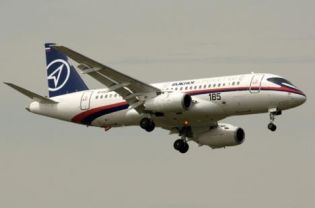
A Sukhoi Superjet 100 takes part in the 48th Paris Air Show at the Le
Bourget airport near Paris in this June 17, 2009 file photo. A Russian Sukhoi
 passenger plane with 46 people on board, including businessmen and Russian
 envoys, has gone missing during a demonstration flight over West Java in Indonesia,
officials said on May 9, 2012. (Reuters Photo/Benoit Tessier)
              
Related articles

Moscow. The Sukhoi jet that crashed in Indonesia killing all on board was a replacement for another plane that had carried out the first part of a promotional tour, its manufacturer said on Monday.

The Sukhoi Superjet 100 — the first new passenger plane produced by Russia since the collapse of the USSR — was making an exhibition flight in Indonesia on a promotional tour to drum up business.

But the plane that crashed was not the same aircraft that carried out the first part of the promotional tour in Kazakhstan and Pakistan, Olga Kayukova, the spokeswoman for Sukhoi Civil Aircraft which makes the plane told AFP.

The Moskovskiy Komsomolets and Kommersant newspapers earlier reported that the plane had been replaced in the middle of the exhibition tour.

Kayukova said that the first model had returned to Moscow after the Kazakhstan leg “to take part in tests,” without giving further details on the reason.

But she added that the second plane was in “perfect technical condition before the flight.”

Images of the planes’ registration numbers posted by bloggers who had been following the whole tour confirmed the reports.

Moskovskiy Komsomolets said that the Superjet shown off in Kazakhstan and Pakistan was number 97005 while the model which crashed in Indonesia was number 97004.

“Why it was replaced, I cannot say,” the paper quoted a source as saying. “But if it was not allowed to make further demonstration flights there must have been a cause.”

It had previously been assumed that the Superjet which crashed last week was the same plane that made the first part of the promotional tour.

At least 45 people, mostly Indonesian airline representatives and eight Russians were on board the plane, which slammed into a dormant volcano after takeoff on Wednesday.

Its loss was a huge blow for the Superjet project, which legendary Russian plane maker Sukhoi hopes will be a major player in the short haul aviation market. So far there have been no official word on the cause of the crash.

Agence France-Presse

Sunday, May 13, 2012

Indonesia Airline Boom Raises New Safety Questions

Jakarta Globe, May 13, 2012

This photo taken on May 11, 2012 and released by Indonesian volunteer
 rescue group Relawan 37 on May 13, 2012 shows an Indonesian soldier
looking at wreckage of the Russian Sukhoi Superjet 100 on the slopes of
Mount Salak, in West Java. Dozens of Russian experts combed a remote
 mountainside in Indonesia on May 13 searching for the flight recorders of a
 Sukhoi jet that slammed into a dormant volcano killing everyone on board.
(AFP Photo/Ho/Duyeh Cidayu/Relawan 37)
              
Related articles

Dozens of fledgling airlines that have sprung up to serve Indonesia’s island-hopping new middle class could jeopardize the archipelago’s recently improved safety reputation, aviation experts say.

The trend threatens to erode higher standards established during what one analyst called a “tremendous amount of soul searching” by major carriers and the government after 2007, when frequent crashes prompted the European Union to ban all Indonesian airlines from landing on its runways for two years.

With growth rates of nearly 20 percent per year, Indonesia is one of Asia’s most rapidly expanding airline markets, but the country is struggling to provide qualified pilots, mechanics, air traffic controllers and updated airport technology to ensure safety. And with so many new, small carriers, it’s hard to monitor all their standards.

“We are not ready for this boom,” said Ruth Simatupang, an Indonesian aviation consultant and former safety investigator.

Indonesia’s two largest airlines — national carrier Garuda and rapidly expanding boutique airline Lion Air — haven’t had a fatal accident in five years and eight years, respectively. But small passenger and cargo carriers plus military aircraft have kept the frequency of crashes to about once every two months, according to statistics compiled by the Aviation Safety Network.

Just how fast Indonesia’s airline market is growing came under a spotlight with Wednesday’s deadly crash of a Sukhoi Superjet 100 plane during a demonstration flight. While both the plane and the pilot were Russian, the flight was packed with representatives of local airlines that the manufacturer hoped would purchase the jetliner.

The number of air passengers in Indonesia jumped by 10 million in a year to 53 million in 2010, according to the government statistics agency, and the upward trend continued last year.

“Infrastructure hasn’t kept pace with the growth of the airlines,” said Shukor Yusof, an aviation analyst in Singapore for Standard & Poors.

He said the government needs to “spend a vast amount of money” to expand safety monitoring for the new carriers and invest in airport runways and technology. He added that the relative ease with which new airlines can be established, though tightened in recent years, has been a concern in the aviation community for years.

In the past five years, Indonesia has added 36 new passenger and cargo airlines, bringing the total to 86 — many of them small carriers serving outlying islands where the only travel alternatives are ferries.

Feeding the demand for new air routes are Indonesia’s population of 240 million, its geography of 18,000 islands and an economy that grew at a 6.5 percent clip last year, creating a larger middle class eager to travel.

“Indonesia is a natural market for growth,” said Brendan Sobie, chief Southeast Asia representative for the Centre for Asia Pacific Aviation. “It’s one of the world’s biggest populations and one of the world’s most underserved markets for airlines.”

Transportation official Herry Bakti Singayuda insists that Indonesia’s rapid airline growth is still compatible with safety.

“We evaluate the operators,” said Singayuda, who directs the Air Transport Department under the Ministry of Transportation. “We control that growth based on their capability, their facilities and personnel.”

He added that the government has expanded flight schools, hired new inspectors and added 10 regional offices to keep up with the new airlines.

Yusof agrees the government and major carriers have markedly improved safety standards in the five years since the EU blacklist, which followed fatal crashes by Garuda and now-defunct Adam Air in 2007.

The government responded with a raft of new regulations and training schools, while Garuda invested millions of dollars to train staff and upgrade its fleet. Lion Air, which recently placed the largest-ever order for Boeing aircraft — 230 planes listed at some $22 billion — has also sought to improve safety, though it took a blow when several of its pilots were arrested in recent months with illicit drugs.

“Garuda and Lion Air have done a tremendous amount of soul searching in terms of safety and in bringing in experts ... to help them clean up their act,” Yusof said. The newer airlines, however, may need more scrutiny.

Smaller airlines serving the domestic market may have less money to invest in training and hiring qualified pilots and mechanics, said Simatupang, the Indonesian aviation consultant.

“There are a lot of new pilots whose flying hours don’t meet the minimum standards, but because the operators need them, they use them sometimes,” she said.

Like Yusof, Simatupang called on the government to do more to regulate the new airlines.

“I always say to the government, please do the new infrastructure and safety regulations first,” she said. “And then allow the airlines to expand.”

Saturday, May 12, 2012

Dangdut and Phone Sex Fly Into Cockpits

Jakarta Globe, Rizky Amelia, May 12, 2012


Indonesia's air frequencies are often muddied by
 crossed signals that cause Indonesian radio and
cell phone conversations to crowd out radio
communication, a senior Indonesian pilot said. (Agency Photo)


Related articles

A senior Indonesian pilot said that unwanted dangdut songs and even phone sex often clog radio communications as pilots enter Indonesian airspace, distracting them from their work.

“Foreign pilots entering Indonesian airspace often say ‘we’re flying into hell,’” Jeffrey Adrian, a senior pilot working with flag carrier Garuda Indonesia Airways, said on Saturday.

Jeffrey said “frequency leakage” has caused phone conversations and radio broadcasts to be heard in the cockpit.

“We often hear dangdut songs, drama and jazz music when entering certain regions,” Jeffrey said. “Phone calls between people can also be heard — I even once heard people having phone sex.”

Jeffrey said that the frequency leakage often disturbs pilots, especially while they’re listening to Air Traffic Control.

“[Pilots] have to work extra to listen to the guidance from ATC.”

In the wake of the tragic Sukhoi passenger jet crash, speculation has been swirling regarding the cause of the accident. Roy Suryo, a telecommunication expert, denied rumors that a cell phone might have interfered with the plane’s navigation system.


Wednesday, May 9, 2012

Russian passenger jet reported missing in Indonesia

BBC News, 9 May 2012

Related Stories 

This image shows a Superjet on a
display flight in India in March
A Russian Sukhoi Superjet 100 passenger plane with at least 44 people aboard has gone missing on a demonstration flight in Indonesia, reports say.

The plane disappeared from radar screens during a flight from Jakarta meant to last 30 minutes, a blogger with the Sukhoi delegation said.

Helicopters were dispatched to look for the jet, thought to have been flying near a mountain, Sergey Dolya said.

Emergency services confirmed a Sukhoi plane was missing.

The plane, which took off at 07:00 GMT, is believed to have had about four hours' fuel aboard, the BBC's Karishma Vaswani reports from Jakarta.

Gagah Prakoso, spokesman for Indonesia's national search and rescue agency, said 46 people had been aboard the plane, which vanished from radar near Bogor, a city in West Java province.

He told BBC News it was unclear who was on board because they were people invited by Sukhoi, but they were "likely to be reps of Indonesian airlines".

Dolya tweeted that there were 44 people aboard, eight of them Russians.

'Guests aboard'

The plane took off from east Jakarta's Halim Perdanakusuma airport, which is used for some commercial and military flights, at 14:00 (07:00 GMT), the Indonesian search and rescue agency spokesman said.

"At 14:50 it dropped from 10,000ft [3,000m] to 6,000ft," the agency told AFP.

Herry Bakti, head of the transport ministry's aviation division, said the aircraft had been on the second of two demonstration flights, and those on board were invited guests.

The Russian embassy in Jakarta said in a statement earlier this week that a Sukhoi Superjet 100 demonstration would take place in Jakarta on Wednesday, AFP added.

The embassy could not be immediately reached for comment.

The Superjet, a mid-range airliner that can carry up to 100 people, is military plane-maker Sukhoi's first commercial aviation plane.

It was created by a joint venture, majority-owned by Sukhoi, with Italy's Finmeccanica and a number of other foreign and Russian firms also involved.


Sunday, May 6, 2012

Seven dead as troubled tourist bus overturns in Pasuruan

The Jakarta Post, Jakarta, Sun, 05/06/2012

Seven passengers of a Mutiara Indah Murni tourist bus died Sunday as bus they were traveling in crashed in Ngembal village, Tutur (Nongkojajar) district in Pasuruan regency, East Java, on Sunday.

Five passengers died on the scene, while two other died on the way to Ganesha Medica hospital in Purwosari.

Survivors said they smelled burning braking pads just before the accident as the bus was rolling downhill. Passengers said the bus went out of control, especially after the driver, Slamet, slammed to the left in an attempt to avoid a motorcycle, kompas.com reported on Sunday.

Unfortunately, one of the bus’ wheels struck a large stone, causing the bus to roll several times before coming to rest on the shoulder of the opposing lane, blocking traffic along the highway.

The bus carried some 60 residents taking a tour from the Candi Lontar housing complex, located in the Sambikerep district of Surabaya, East Java.

They had just visited the Agro Bhakti Alam tourism site in Ngembal village and were heading for the Sengkaling public bath in Malang regency. The bus had only traveled two kilometers from Agro Bhakti Alam when the accident occurred.

One of the passengers, Sasongko, said the bus had broken down in the Purwosari area on their way to Ngembal village.

He said the radiator leaked and the bus had braking problems. “The driver sealed the leakage simply using a bar of soap. The leaking radiator showed that the bus was not roadworthy,” he told kompas.com.

Nongkojajar Police chief Adj. Comr. Marwan Ishari Purnomo said the police had detained the driver for further questioning. 

Friday, May 4, 2012

A380 makes emergency landing in Jakarta

The Jakarta Post, Sita W. Dewi, Jakarta, Fri, 05/04/2012

Emergency landing: A Singapore Airlines A380 flying from Sydney, 
Australia, to Singapore makes an emergency landing at Jakarta’s Soekarno
 Hatta International Airport on Friday over a passenger’s medical condition.
 It was the first time that an Airbus A380 has landed at the airport, which
 was previously believed to be not feasible for such a large aircraft. 
(JP/Sita Dewi, Angkasa Pura II files)

A Singapore Airlines A380 flying from Sydney, Australia, to Singapore made an emergency landing at Jakarta’s Soekarno Hatta International Airport on Friday over a passenger’s medical condition.

“The pilot contacted Soekarno-Hatta airport’s tower to ask for landing permission when it was flying over Bali because one of its passenger needed emergency first-response,” state airport-operator Angkasa Pura II executive director Tri Sunoko said in a statement sent to The Jakarta Post.

Tri said the plane, which was carrying 280 passengers and 26 crew members, managed to land on Runway 07-L and parked at Apron WC-1.

The airplane also refueled at the airport.

Tri said that the evacuation process went well and that the plane flew to Singapore at 5:50 p.m., around two hours after the emergency landing, without two passengers.

It was the first time that an Airbus A380 has landed at the airport, which was previously believed to be not feasible for such a large aircraft.

The airport aims to expand its capacity from 22 million passengers per year to 62 million by 2014.


Wednesday, April 11, 2012

Airbus gets multi-billion-dollar order from Indonesia

Deutsche Welle, 11 April 2012


European aircraft manufacturer Airbus will build 11 more long-haul passenger jets for Indonesia. The deal, worth almost two billion euros ($2.5 billion), will help the company overcome its current shortage of orders.

Indonesia's flag carrier Garuda will purchase 11 A330 jets for long-distance travel from Europe's leading plane producer, Airbus. The deal seems more than welcome for the multinational company, which has only secured firm orders for 90 planes in the first quarter of 2012, compared with more than 400 for US rival Boeing.

The current order is worth 1.9 billion euros ($2.5 billion) at catalog prices. The new Airbus planes will be driven by UK-supplied Rolls-Royce engines.

"This deal between Airbus and Garuda Indonesia Airlines is great news for the UK aerospace industry," British Prime Minister David Cameron told reporters after arriving in Jakarta for a 24-hour visit.

The 11 long-haul A330s will increase by two thirds the number of passenger jets already delivered to Garuda, which is majority state-owned. Its main domestic rival Lion Air in February signed a record $22-billion deal for planes from Boeing.

Rising number of passengers

Garuda's Chief Executive, Emirsyah Satar, said he planned to use the new Airbus planes to expand in the Asia-Pacific region, including China, South Korea and Australia.

Indonesia has been witnessing a rapidly expanding aviation sector, as a growing middle class and business executives opt to travel by air across an archipelago of 17,000 islands. It's considered a more reliable way to travel, because many islands lack good roads or railways and ship connections are sporadic.

Asia and the Middle East currently offer the best prospects for plane sales by Airbus and other major jet manufacturers like Boeing, Bombardier or Embraer.

hg/gb (Reuters, dapd, AFP)

Thursday, April 5, 2012

How to land a plane in an emergency

Our expert's advice: turn on the radio, look for a safe place to land and keep the aircraft steady

The Guardian, by Leo Hickman, 4 April 2012

The emergency-landed Cessna itself, safe on the tarmac.
Photograph: Associated Press/Door County Sheriffs Office

Earlier this week, an 80-year-old woman landed safely at an airport in Milwaukee after taking the controls of her husband's Cessna aircraft when he died of a heart attack. Dave Smith, an instructor with Redhill Aviation in Surrey, explains what to do if you ever find yourself in such a predicament …

1 Locate the radio. Just like in a car, you will find it in the centre of the dashboard. Don't adjust the frequency as it will probably already be set correctly. Locate the PTT (Press To Talk) button. Press it and speak to the control tower, who will "talk you down" just like in the movies. If they don't hear you, switch the frequency to 121.5, which is monitored by the RAF. Failing that, look for the transponder on the dashboard and dial in 7700, which is the "emergency squawk" code. Hopefully, the control tower will then be able to send up a plane to fly alongside and hand signal instructions to you. But if all that fails …

2 Look for a large green field. Start gently – very gently – touching the control column to see what each move achieves. Keep the wings level.

3 Find the throttle. It looks like the top of a cafetiere. Pull the knob very gently towards you to decrease power. Push away to increase power.

4 Keep in a straight line. If you have to turn – say, to circle to a landing spot – don't bank more than 5-10 degrees.

5 Perform a controlled crash. It takes a lot of practice to land on your back wheels first, so it is likely you will land on the front wheel. A Cessna will land at about 60-70mph so be prepared for an abrupt halt. Good luck.

Wednesday, April 4, 2012

The Dutch flying car

RNW, 3 April 2012 

Avoiding traffic jams by taking to the skies is a fantasy for many motorists. Their dream is now a step closer to reality with the unveiling of Dutch manufactured PAL-V One.

The new flying car took its first flight a few weeks ago at Gilze-Rijen Airbase. The aircraft circled part of the countryside in the province of Brabant at height of 400 metres.

The test flight was conducted without incident. Completion of the initial test flights is necessary before the green light will be given for a production model to be manufactured. The hope is that the PAL-V One could be available to consumers by the end of 2014.

The PAL-V one is a three-wheeler with a propeller and rotor blade that can fold away.


Related Article:


The Transition has two seats, four wheels and wings 
that fold up so it can be driven like a car. Photograph:
Terrafugia Inc/AP


Tuesday, March 20, 2012

Angry minister becomes Twitter trending topic

Sita W. Dewi, The Jakarta Post, Jakarta, Tue, 03/20/2012

State-Owned Enterprises Minister Dahlan Iskan’s move of exiting his car, which was stuck in a long queue backed up in front of a Jakarta toll gate, forcefully opening the gates of two unattended toll lanes and allowing 100 vehicles to drive through for free on Monday morning has stirred up a deal of public attention.

The minister also reportedly reprimanded state-owned toll operator PT Jasa Marga’s top management shortly after the incident.

The keyword “Dahlan Iskan” is now being named as one of the trending topics in Indonesia on Twitter today. Most of the tweets praised the minister’s move -- some of them even encouraged the media mogul to run for president in 2014.

“Mr. Dahlan Iskan FTW! He’s so cool! All public officials should have done this!” said account @jojosuherman.

Noted composer Addie MS posted on Twitter: “Dahlan Iskan let cars pass without paying toll fees to break the long queues, and reprimanded Jasa Marga’s executive director soon after. [The director] deserved that!”

Meanwhile, account @adjisdoaibu questioned the minister’s actions, asking, “Why did he do that? Couldn’t he wait? Would he be as angry as that if the queue had been caused by the President’s motorcade?”

On his Twitter account, Dahlan said he was not furious; he only wanted to break the frustrating traffic congestion.

The minister was on his way to a meeting at national flag carrier Garuda Indonesia’s office when he got caught in a line of about 30 cars waiting to enter the Semanggi toll gate in Slipi, West Jakarta at around 6 a.m.

“I was not only angry, I was extremely furious,” he was quoted as saying this morning.