More carmakers caught in headlights of VW engine-rigging scandal

More carmakers caught in headlights of VW engine-rigging scandal
Volkswagen has admitted it installed illegal software into 11 million 2.0 liter and 3.0 liter diesel engines worldwide (AFP Photo/Josh Edelson)

Volkswagen emissions scandal

Iran's 'catastrophic mistake': Speculation, pressure, then admission

Iran's 'catastrophic mistake': Speculation, pressure, then admission
Analsyts say it is irresponsible to link the crash of a Ukraine International Airline Boeing 737-800 to the 737 MAX accidents (AFP Photo/INA FASSBENDER)

Missing MH370 likely to have disintegrated mid-flight: experts

Missing MH370 likely to have disintegrated mid-flight: experts
A Malaysia Airlines Boeing 777 commercial jet.

QZ8501 (AirAsia)

Leaders see horror of French Alps crash as probe gathers pace

"The Recalibration of Awareness – Apr 20/21, 2012 (Kryon channeled by Lee Carroll) (Subjects: Old Energy, Recalibration Lectures, God / Creator, Religions/Spiritual systems (Catholic Church, Priests/Nun’s, Worship, John Paul Pope, Women in the Church otherwise church will go, Current Pope won’t do it), Middle East, Jews, Governments will change (Internet, Media, Democracies, Dictators, North Korea, Nations voted at once), Integrity (Businesses, Tobacco Companies, Bankers/ Financial Institutes, Pharmaceutical company to collapse), Illuminati (Started in Greece, with Shipping, Financial markets, Stock markets, Pharmaceutical money (fund to build Africa, to develop)), Shift of Human Consciousness, (Old) Souls, Women, Masters to/already come back, Global Unity.... etc.) - (Text version)

… The Shift in Human Nature

You're starting to see integrity change. Awareness recalibrates integrity, and the Human Being who would sit there and take advantage of another Human Being in an old energy would never do it in a new energy. The reason? It will become intuitive, so this is a shift in Human Nature as well, for in the past you have assumed that people take advantage of people first and integrity comes later. That's just ordinary Human nature.

In the past, Human nature expressed within governments worked like this: If you were stronger than the other one, you simply conquered them. If you were strong, it was an invitation to conquer. If you were weak, it was an invitation to be conquered. No one even thought about it. It was the way of things. The bigger you could have your armies, the better they would do when you sent them out to conquer. That's not how you think today. Did you notice?

Any country that thinks this way today will not survive, for humanity has discovered that the world goes far better by putting things together instead of tearing them apart. The new energy puts the weak and strong together in ways that make sense and that have integrity. Take a look at what happened to some of the businesses in this great land (USA). Up to 30 years ago, when you started realizing some of them didn't have integrity, you eliminated them. What happened to the tobacco companies when you realized they were knowingly addicting your children? Today, they still sell their products to less-aware countries, but that will also change.

What did you do a few years ago when you realized that your bankers were actually selling you homes that they knew you couldn't pay for later? They were walking away, smiling greedily, not thinking about the heartbreak that was to follow when a life's dream would be lost. Dear American, you are in a recession. However, this is like when you prune a tree and cut back the branches. When the tree grows back, you've got control and the branches will grow bigger and stronger than they were before, without the greed factor. Then, if you don't like the way it grows back, you'll prune it again! I tell you this because awareness is now in control of big money. It's right before your eyes, what you're doing. But fear often rules. …

Showing posts with label Buses. Show all posts

Friday, July 7, 2017

Dutch scientists develop first bus to run on formic acid

DutchNews, July 6, 2017

A hybrid bus in Eindhoven. Photo: Wikimedia Commons

There could be a sting in the tail on the way for bus passengers – Dutch scientists have unveiled the first electric passenger vehicle to run on formic acid. 

A team at Eindhoven University of Technology have built the prototype bus, which uses formic acid to generate hydrogen and carbon dioxide. Formic acid is the poison carried in the stings of ants, wasps and nettles. 

Max Aerts, head of the development team, said formic acid was a cost-effective way to create hydrogen as fuel. ‘The big advantage of formic acid is that you can put it in the fuel tank’, he said. ‘The cost of rebuilding a petrol station is relatively low.’ 

Formic acid is easy to synthesise and cheaper and easier to store than pure hydrogen, which has to be kept in pressurised containers, Aerts explained. 

Aerts told Omroep Brabant he expected the first buses adapted for formic acid to be running on the roads within one to four years. 

Thursday, July 21, 2016

University of Indonesia Designs, Launches Electric Car and Bus

University of Indonesia's electric bus was shown at UI Engineering Center,
 Depok, West Java, on Monday (18/07). (Photo courtesy of University of Indonesia)

Jakarta. The University of Indonesia on Monday (18/07) launched four electric vehicles designed by campus engineers at the university's engineering center in Depok, West Java.

The launch featured a bus and three city cars, with one car named Makara, after the UI logo.

The bus has been tested and will be used on campus, replacing traditional buses, to transport students.

The Molina UI team of engineers have also researched the impact of electric cars on economic, social, cultural and legal aspects within the community. A solar-powered recharge station is also in the development stage to complement the cars.

"Soon, this electric bus will operates transporting students around the campus to support UI green campus vision," UI rector Muhammad Anis said in a statement received by the Jakarta Globe on Tuesday (19/07). "Considering that air pollution is already harming our society, this initiative is expected to push that issue."

"It also encourages students to master technology and not be dependable on the major car industry that has made Indonesia consumers."

Tuesday, July 19, 2016

Self-driving bus passes first road test

DutchNews, July 18, 2016

Driverless buses could be in
service by 2020.
Self-driving buses have been tested on the open road for the first time between Schiphol airport and Haarlem. 

The buses are equipped with 20 cameras that can react to traffic lights and programmed to travel in the middle of the road. A driver sits at the controls ready to step in if the automatic system fails, BNR reported

The goal is to have the first automatic buses in service by 2020. ‘I think it’s going to be a while before we can be driven around automatically in any kind of vehicle,’ said Edith Post, of the North Holland provincial assembly, at the official launch in Amsterdam. ‘But we think it’s important to make our roads accessible and carry out these kinds of tests.’

Friday, January 29, 2016

Dutch get ready for road trials of driverless car

DutchNews, January 28, 2016

Experiments with self-driving cars will take a new direction on Thursday when the WEpod trials in Wageningen take to the university campus roads. 

The WEpod shuttle buses, which have no steering wheel or pedals, are electric and have a maximum speed of 25 kph. 

If the campus trials are a success, June will see the shuttles begin to use public roads, travelling a pre-programmed route between Bennekom and the Ede-Wageningen railway station. The Dutch driving authority RDW has given official permission for the trials to take place. The project owners say this is the ‘test phase of the first pilot in the world of a self-driving vehicle on a public highway‘. 

The shuttle buses cannot be used at night or in bad weather and each will have a steward on board who will use a joystick control on two busy sections of the route. 

The WEpods project is a joint venture between the Gelderland university, Delft University, the TNO research institute and others. Gelderland province has put €3.4m into the project as part of its efforts to find flexible and more sustainable options than traditional regional bus services.

Sunday, March 15, 2015

UK's first 'poo bus' goes into regular service

Bio-Bus fuelled by human and household waste, which first ran between Bristol and Bath, will operate 15-mile route four days a week

The Guardian, Press Association, Sunday 15 March 2015

Bristol’s Bio Bus runs on faeces and household waste. Photograph: Ben Birchall/PA

Britain’s first “poo bus”, which runs on human and household waste, goes into regular service later this month.

Powered by biomethane gas, the Bio-Bus will use waste from more than 32,000 households along its 15-mile route.

Operated by First West of England, the bus will fill up at a site in Avonmouth, Bristol, where sewage and inedible food waste is turned into biomethane gas.

The bus, which can seat up to 40 people, was unveiled last autumn. First is showing the bus in Bristol on Tuesday before it starts operating four days a week from 25 March.

If the route is successful, First will consider introducing more “poo buses”. The managing director, James Freeman, said: “Since its original unveiling last year, the Bio-Bus has generated worldwide attention and so it’s our great privilege to bring it to the city.

“The Bio-Bus previously made an appearance running between Bath and Bristol airport at the end of last year, but it’s only actually been used once before in the centre of Bristol itself.

“The very fact that it’s running in the city should help to open up a serious debate about how buses are best fuelled, and what is good for the environment.”

Related Articles:


Sunday, January 11, 2015

Dozens killed as bus collides with oil tanker in Pakistan

At least 57 people, including women and children, have been killed after a bus crashed into an oil tanker in southern Pakistan. The accident led to a fiery blaze, making rescue attempts difficult.

Deutsche Welle, 11 Jan 2015


The overloaded bus was on its way to Shikarpur from Pakistan's commercial capital, Karachi. Senior police officer Rao Muhammad Anwaar said the bus "hit the oil tanker which, according to initial reports, was coming from the wrong direction."

The accident led to a fierce blaze, which was put out by the fire brigade, but not until both the bus and the tanker were completely consumed, Pakistani newspaper The Express Tribune reported. Rescue workers had to cut through heavy machinery to reach the victims, it said.

A few passengers escaped by jumping out of the windows.


"We have received more than 57 dead bodies but the death toll may rise as most of them are completely burnt and stuck to each other," Semi Jamali, a doctor at Karachi's Jinnah hospital, told news agency Agence France Presse.

Bodies that were badly burnt would have to be identified using DNA tests, Jamali added.

The accident was the second collision within a span of three months. In November, 57 people including women and children were killed when a bus crashed into a goods truck loaded with coal.

Pakistan has a record number of fatal travel accidents, owing mainly to bad roads and reckless driving.

mg/cmk (AFP, AP)

Monday, January 5, 2015

Nepal introduces women-only buses to combat groping

RTE News – AFP, Monday 5 January 2015

In 2013 26% of women aged between 19 and 35 said they had experienced
some form of sexual assault on public transport in Nepal

Nepal has introduced women-only minibuses in its capital city, in a bid to protect female passengers from sexual assault.

The initiative has begun with "women-only" signs being placed on four 17-seater minibuses and they will operate on key routes in Kathmandu during morning and evening rush hour.

"Groping and sexual assault is a problem for women who use buses, especially during peak hours when buses are overcrowded," said Bharat Nepal, President of the Bagmati Federation Transport Union, which introduced the service.

"This is our small initiative to make commuting safe and secure for female travellers," he added.

Only one of the buses currently has a female conductor but he said that the goal was to eventually employ an all-women crew.

In a 2013 World Bank survey, 26% of female respondents aged between 19 and 35 said they had experienced some form of sexual assault on public transport in Nepal.

In 2011 a 21-year-old Buddhist nun was gang raped in a bus in eastern Nepal by five men, including the bus driver.

Complaints about groping prompted authorities in neighbouring India to introduce women-only carriages on the metro system in the capital New Delhi in 2010.


Pakistani hostess from newly launched Tabeer Women Transport Service waits
for commuters at bus stop in Islamabad on March 5, 2014 (AFP/File, Aamir Qureshi)

Related Article:


Wednesday, August 27, 2014

At least five dead in South Korea flash floods

BBC  News, 26 August 2014

A bus was washed away by floods, killing one and leaving four more people missing

Related Stories

Flash floods brought on by heavy rain in southern South Korea have killed at least five people, officials say.

One person was killed and four others are missing after a bus was swept away by floods near the southern city of Changwon, Yonhap news agency reported.

In Busan, South Korea's second-largest city, four people were killed after heavy rain battered parts of the city.

Victims included two people who drowned in their car after driving through a submerged city underpass.

An engineer is also believed to be missing after checking basement power lines in a flooded building.

More rain is forecast for the south of the country, weather officials say

Monday's heavy rain also disrupted train services in Busan, and a nuclear power plant was forced to halt operations after a cooling facility became flooded, AFP news agency reported.

Weather officials said that more heavy rain was forecast.

Saturday, August 9, 2014

Ranting bus passenger forced to make public apology

Want China Times, CNA and Staff Reporter 2014-08-09

Jackson Chu, right, apologizes to the bus driver he subjected to a verbal
assault, Aug. 8 (Photo/CNA)

A Taiwanese American man who recently threw a tantrum on a bus and verbally assaulted the driver in a foul-mouthed tirade in English made an open apology to the driver on Friday.

Jackson Chu called the Taoyuan Bus Co to say that he wished to apologize to the driver, Chen Chin-chi, in private, a request that was rejected outright by the company given the notoriety of the incident, which had been captured by a fellow passenger who uploaded it to the internet. The video swiftly went viral and pitchforks were out for the "foreigner," as the poster supposed him to be, as did the first media outlets to jump on the story.

The company insisted instead that Chu instead make an open apology at a police station, so he presented himself at a police station later that day where he read a statement in halting Mandarin Chinese interspersed with English.

Chu said it was not right for him to have used bad language and that he was "impolite." He apologized to Chen and the passengers on the bus.

Chu also asked Chen's forgiveness and expressed hope that he can continue to ride on his bus. He and Chen then shook hands and hugged, with Chen saying that he forgave Chu and welcomes him to use his bus again.

"We are a happy country, he is our guest and we welcome him to take our bus. He has said sorry and that will do," Chen said, adding that he did not want a minor dispute to turn into a big confrontation.

Chen said that although he did not understand all of Chu's Chinese, he felt his sincerity.

The bus company, which had earlier decided to file a lawsuit against Chu, said the incident "has come to a happy conclusion" and that it would drop the suit.

Chu lost his temper when the driver went past his stop — witnesses claim he pushed the bell too late — and swore and used intimidating body language as he demanded the driver apologize.

Chu's behavior was widely condemned online and internet users used a "human flesh search" to identify him and publish information about him and his wife, who was also present during the incident. The practice of seeking out and shaming people who break the rules of social conduct is common in China, but is not seen so often in Taiwan.

When identified as the ranter, Chu initially defended his outburst as "protecting" his pregnant wife, and later threatened to sue the college student who posted the video online, but later decided not to do so.

Monday, August 4, 2014

BYD builds world's biggest electric bus recharging station

Want China Times, Wu Ruei-da and Staff Reporter 2014-08-04

A BYD branch in Los Angeles. (Photo/Xinhua)

BYD, China's leading car manufacturing company, has reportedly built the world's biggest electric bus recharging station that can simultaneously dock 300 buses, reports our Chinese-language sister newspaper China Times.

The recharging station is located in Jiangsu province's capital city of Nanjing. The station, already in operation, includes 150 recharging devices. BYD's achievement is seen as China's determination to develop and promote the use of new energy.

China's authorities announced on July 30 that they will provide preferential electricity subsidies for people who recharge their electric cars. The new policy aims at lowering the costs of recharging electric vehicles to incentivize the use of electric cars.

More recharging booths would be a boon for China's domestic automotive industry, as long as they were distributed across all regions and considered population and driver density.

Each recharging pillar only costs 10,000 yuan (US$1,618) to build. This is pocket change for the Chinese government. The cost for a recharging station is similar to that of a petrol station.

The more recharging stations there are, the more consumers are willing to switch to the use of new energy, said one spokesman in the automotive industry.

BYD intends to build in total 21 recharging stations in Nanjing, which would consist of 976 recharging pillars. They have not given a time frame for completion.

BYD will also provide electric vehicles for the Youth Olympic Games held in Nanjing from Aug. 16 to Aug. 28.

Sunday, May 4, 2014

Sun Moon Lake to introduce electric buses in October

Want China Times, CNA 2014-05-04

Sun Moon Lake in central Taiwan's Nantou county. (File
 photo/Shen Hui-sheng)

Top tourist attraction Sun Moon Lake aims to become Taiwan's first scenic area to use only green tourist buses with the introduction of three electric-powered buses in October, transportation officials said on Saturday.

The buses will replace the three diesel buses running in the area to promote low-carbon travel, officials said.

The area has also introduced 35 electric cars for rent at low prices since April last year, providing rides to nearly 10,000 people as of September, according to the Ministry of Transportation and Communications.

Since over 90% of those users previously relied on their own vehicles to get around the lake area, the plan has cut carbon dioxide emissions by around 11,300 kilograms, the ministry said.

Further promotion of low-carbon transportation could reduce the use of private vehicles from 41.7% to 34%, the ministry predicted.

Thursday, February 20, 2014

Jakarta Governor in Mission to Rid City’s Procurement Process of Graft

Jakarta Globe, Lenny Tristia Tambun & Markus Junianto Sihaloho, February 19, 2014

The Jakarta administration so far this year has received a total of 656 buses.
(SP Photo)

Jakarta. Jakarta Governor Joko Widodo is using the investigation of fraud into the Rp 113 billion ($9.6 million) purchase of new buses as shock therapy and leverage to rid the city’s notoriously rigged procurement processes of corruption.

Joko and his deputy, Basuki Tjahaja Purnama, vowed to bring those officials involved in the markups in the purchase to justice, an unprecedented move that could set an example of how the country could get rid of corruption in procurement processes, where the state has allocated more than Rp 400 trillion this year alone, making it the biggest potential source of corruption.

Joko vowed on Wednesday to bring all corrupt officials to book, emphasizing the need for stricter monitoring, management control and field inspections as his administration starts to implement a number of high-value projects.

“We need is better management of control. The city’s inspectorate office may be able to handle the smaller ones, but some projects are very big and we don’t have the necessary monitoring measures. That is what we want to do with the project management office,” Joko said on Tuesday.

Among the bigger projects undertaken by the government this year are the mass rapid rransit project, the monorail project, the TransJakarta project and the construction of low-cost apartments, all of which involve trillions of rupiah from the city coffers.

“This is to assist, monitor, control and audit the bigger projects. But we’re still discussing it,” Joko said.

“The city administration lacks control management, but it is impossible for me to check [on the projects] directly. Even the inspectorate cannot do so. We are assisted by the BPK [Supreme Audit Agency] and the BKPP [Financial Development Comptroller]. The inspectorate currently monitors 57 budgets.”

Indications of fraud have emerged from an investigation by the Jakarta Provincial Inspectorate office into the purchase of new buses, after the units were discovered to be unfit for use shortly after arriving in the capital from China, where they were manufactured.

“I have received the report from the inspectorate about fraud involved in the procurement of the feeder buses and buses for the Integrated City Busway facility. Apparently the irregularity was found in the tender procedure,” Basuki said.

The inspectorate had initially found no issues in the administrative process of the procurement, but eventually discovered several irregularities in tender documents, including a significant increase in prices up to the process of determining the winning tender.

“In China [the buses] are supposed to be priced at Rp 1 billion, but instead it is sold here for Rp 3 billion. So if you look at the documents, of course it is China who benefits most, it is very clear,” Basuki said, adding that he would leave the matter to law enforcement to probe.

Further review

Basuki also called on the BPKP to subject the documents to further review by financial experts and those with knowledge of project implementation issues.

He also indicated that those involved in manipulating the documents tozz conceal the foul play, were Transportation Office officials responsible for the budget and members of the committee involved in the tender process.

“They’re all very smart. The tender committee is also full of problems,” he said.

Chairman of the Jakarta Inspectorate office Franky Mangatas Panjaitan said they would be summoning the goods receipt committee as well as the TransJakarta Management Unit to clarify its findings.

“They will be asked to provide information on the goods receipting procedure and documents pertaining to the inspection of goods that were received,” Franky said.

He called on the public to remain patient while waiting for results from the probe, emphasizing that it was necessary for the institution not rush to any conclusions when making its recommendations.

Franky confirmed that there had been indications of fraud in the tender process.

“However the city administration has not yet received all of the units so we can’t come up with a general conclusion just yet,” he said. “We will have to run tests [on the buses] and test their performance. Only then will we be able to make a finding.”

The city administration so far this year received a total of 656 buses, comprising 346 for the BKTB and 346 for TransJakarta. However, less than a month into their use, 10 BKTB buses and five TransJakarta buses were found to be unfit for use, with some of their components not working properly and being rusted.

Some people have also called on the city administration to involve the Corruption Eradication Commission (KPK) in its investigation.

“The TransJakarta case is best handled by the KPK. We are calling on Basuki to be proactive and report it to the KPK,” said Habiburokhman, central executive board chairman for the Great Indonesia Movement Party (Gerindra), of which Basuki is a member.

The KPK has expressed its willingness to support city officials.

“If they want to report it to the KPK then go ahead. However, as of today, we have yet to receive any reports,” KPK spokesman Johan Budi said on Monday, as quoted by Inilah.com.

The procurement of goods purchased by government institutions have become very prone to acts of corruption.

In the most recent case, the Jakarta High Court sentenced former traffic police chief Djoko Susilo to an 18-year prison term for his involvement in the graft-ridden procurement of driving simulators.

Meanwhile, in Banten, the KPK has also uncovered allegations of embezzlement in the procurement of medical equipment for state hospitals in South Tangerang.

The central government has allocated a total of Rp 201.88 trillion for the purchase of goods and another Rp 205.84 trillion for capital expenditure in its budget for 2014.

Additionally, the state has also allocated Rp 341 trillion to provinces and districts across the country.

A recent Indonesia Corruption Watch report showed that up to 98.12 percent of the 267 corruption cases reported in the second quarter of 2013 were in regional government institutions, most in North Sumatra and East Java.

Last year 35 regional chiefs were mired in graft scandals, prompting ICW to warn of a “corruption emergency” in the country.

Thursday, July 25, 2013

Last Straw for Jakarta’s Unlicensed, Unroadworthy MetroMinis

Jakarta Globe, Hotman Siregar, July 25, 2013

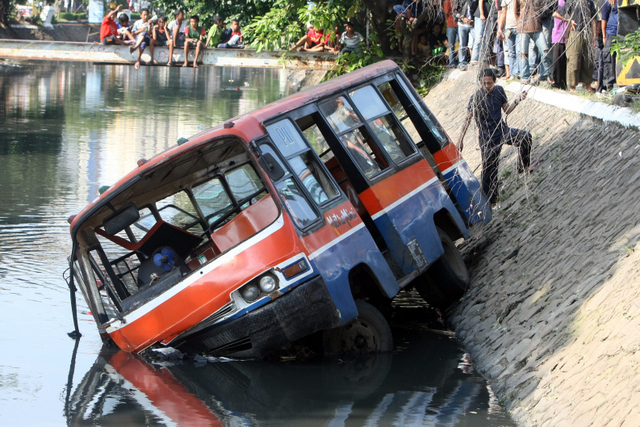
A MetroMini is seen partially submerged in a canal after veering off the
road in Jakarta on Jan. 21, 2009. (JG Photo/Yudhi Sukma Wijaya)

A fatal MetroMini bus accident on Tuesday has led to calls for the Jakarta city administration to take over the long-running public transportation operator.

“The city administration should just take over MetroMini. The developers are illegal and out of control,” Jakarta Transportation Board chief Azas Tigor Nainggolan said at City Hall on Wednesday.

According to Azas, the company behind the MetroMini, the city’s red-and-blue mid-sized buses, had been prohibited from operating in the city since 2009, with its operating permit frozen, therefore making its current activities illegal.

“Those buses have no documents, the drivers do not have driving licenses,” he said, adding that such issues had been a major contributor to various public transportation accidents on the city’s streets.

“The transportation office is not brave enough to crack down [on them]. Their operational licenses should just be revoked altogether,” Azas said.

Not only were the city buses operating without official documents, most of the mid-sized and big buses were in very poor physical condition, he added.

His remarks came a day after a MetroMini bus serving the route between Senen, Central Jakarta, and Pondok Kopi, East Jakarta, was involved in an accident that claimed the life of a middle school student and injured two others.

An investigation into the crash by the East Jakarta Police found the vehicle was not roadworthy, with the clutch held together using a piece of rubber from an inner tube.

“The investigation revealed that the MetroMini bus involved in the crash was not certified for use,” Adj. Comr. Agung Budi Laksono, the head of the police’s traffic accident unit, said on Wednesday.

Police identified the victim as 13-year-old schoolgirl Benity. She was hit by the bus while crossing the TransJakarta bus lane with two friends, Rahmi and Revi, who suffered serious injuries.

The bus driver, identified by police as W.S., admitted that he did not have a driver’s license and that he had been cited by police several times before. He faces up to six years in jail if convicted.

Azas said he appreciated the city administration’s plan to revitalize Jakarta’s public transportation system but asked that emphasis also be placed on traffic law enforcement efforts.

“Before revitalizing transportation, law enforcement has to be strictly implemented,” he said.

Udar Pristono, the head of the Jakarta Transportation Office, echoed Azas’s indignation over MetroMini’s operations, which he said had often placed the lives of commuters in jeopardy, and suggested that the operator be disbanded.

“MetroMini has been operating without a license. It has no operational license. When its buses are stopped [by law enforcement officers], the company still insists on taking other opportunities to operate. This is no longer just the transportation office’s problem,” Udar said on Wednesday, adding that his office had many other transportation-related issues to deal with besides law enforcement.

He suggested that the closure of MetroMini would be the best option, as the operator’s own monitoring efforts had failed.

“MetroMini no longer qualifies to operate in Jakarta. The buses are inadequate. So just disband them,” he said.

Separately, the city administration plans to add a number of mid-sized and bigger buses, including those operated by PPD, a state-owned operator, in an attempt to boost city’s the public transportation fleet.

Sunday, May 6, 2012

Seven dead as troubled tourist bus overturns in Pasuruan

The Jakarta Post, Jakarta, Sun, 05/06/2012

Seven passengers of a Mutiara Indah Murni tourist bus died Sunday as bus they were traveling in crashed in Ngembal village, Tutur (Nongkojajar) district in Pasuruan regency, East Java, on Sunday.

Five passengers died on the scene, while two other died on the way to Ganesha Medica hospital in Purwosari.

Survivors said they smelled burning braking pads just before the accident as the bus was rolling downhill. Passengers said the bus went out of control, especially after the driver, Slamet, slammed to the left in an attempt to avoid a motorcycle, kompas.com reported on Sunday.

Unfortunately, one of the bus’ wheels struck a large stone, causing the bus to roll several times before coming to rest on the shoulder of the opposing lane, blocking traffic along the highway.

The bus carried some 60 residents taking a tour from the Candi Lontar housing complex, located in the Sambikerep district of Surabaya, East Java.

They had just visited the Agro Bhakti Alam tourism site in Ngembal village and were heading for the Sengkaling public bath in Malang regency. The bus had only traveled two kilometers from Agro Bhakti Alam when the accident occurred.

One of the passengers, Sasongko, said the bus had broken down in the Purwosari area on their way to Ngembal village.

He said the radiator leaked and the bus had braking problems. “The driver sealed the leakage simply using a bar of soap. The leaking radiator showed that the bus was not roadworthy,” he told kompas.com.

Nongkojajar Police chief Adj. Comr. Marwan Ishari Purnomo said the police had detained the driver for further questioning. 

Wednesday, August 25, 2010

China's 3D Fast Bus Expected to Operate in 2011

CRIENGLISH.com, Web Editor: Zhao, 2010-08-25

4.4 to 4.5 meters high, the 3D fast bus will travel at an average speed of 60 to 80 kilometers an hour, faster than current buses, which could reduce traffic jams by 25 to 30 percent on main routes. [Photo: the Beijing Times]


A Chinese invention, the 3D fast bus, has recently passed its security evaluation and was sent to the manufacturing section on Tuesday. The bus is expected to beput into operation by the end of 2011, the Beijing Times reported.

The bus,with one story of passenger space above the ground, straddles the street and allows cars to drive under it. Powered by a combination of municipal electricity and solar power, the bus will travel at an average speed of 60 to80 kilometers an hour, faster than current buses, which could reduce traffic jams by 25 to 30 percent on main routes.

The passenger carts of the 3D fast bus, which can hold 1,200 passengers per vehicle, are flexible and can be added to create more passenger capacity during rush hour, or just leave one or two carts in operation during off-peak time.The departure intervals can also be adjusted, according to Song Youzhou, the designer of the bus.

The cost of constructing this bus system is 50 million Yuan (or 7.4 million U.S.dollars) per kilometers, which is roughly one-tenth the cost of building a subway of the same length.

The vehicles will be built by the China South Locomotive and Rolling Stock Corporation. The bus track in the Mentougou district of Beijing will startconstruction at the end of this year, according to the authority of science office, Mentougou district.


Vehicles on the road through the central business district in Beijing on August 4. Thousands of vehicles are bogged down in a more than 100-kilometre (62-mile) traffic jam lon the Beijing-Tibet expressway that has lasted nine days and highlights China's growing road congestion woes. (AFP/File/Liu Jin)


Related Article:

Saturday, March 21, 2009

Bus crews told not to leave public stranded

Triwik Kurniasari, The Jakarta Post, JAKARTA | Sat, 03/21/2009 10:39 AM


Gridlock: A police officer directs traffic on Jl. Asia Afrika in Central Jakarta on Friday. The traffic was brought to a stand-still as supporters of The Democratic Party flocked to a rally at Bung Karno Stadium. (JP/Arief Suhardiman)

The Jakarta chapter of the Organization of Land Transportation Owners (Organda) has called on public transportation operators not to rent their vehicles out for political campaigns, saying they should prioritize public passengers.

TR Panjaitan, secretary of Organda, said he received complaints that many passengers were stranded due the lack of buses during campaign rallies.

“Public needs should come first. The problem is, sometimes bus operators do not even know that their fleets are rented to political parties.”

“The parties usually come to the bus drivers to rent the buses for rallies, and not the owners of the buses.

“And the drivers will usually take the offers because the money is much more than would earn from a normal days work,” he said on Friday.

During the public campaign period, political parties will stage rallies everyday in each province across the country. The parties usually rent buses and bus crews to transport supporters to campaign venues or using them in motorcades.

He said his office would monitor every campaign venue to reprimand bus crews that neglect their duty.

Panjaitan however acknowledged that it is beyond Organda’s authority to impose sanctions.

Riza Hasyim, from the transportation agency, said his office could not penalize the bus operators.

“We don’t have the right to forbid them not to rent their buses for campaign rallies. The decision is fully on the bus operators’,” Riza said, adding, “We just hope that bus operators will use their reserve buses instead of the regular ones.”

Panjaitan said parties should use charter buses. “We have about 1,500 buses. But they [those parties] might be reluctant to rent those buses since they are costlier.”

In other developments on transportation issues, the administration said Friday that it would impose stricter sanctions on illegal on-street parking in the capital, saying it will also revise the bylaw on parking.

“The current parking bylaw imposes lenient sanctions. We need a stricter one,” Governor Fauzi Bowo said Friday. “Cities in the U.S., for instance, not only fine violators, but they also tow and seize the cars.”

“This is a good and effective way of enforcing parking bylaws. We will think of some ways like that to implement the ruling,” Fauzi said.


Friday, March 13, 2009

Owners defy plan to free arteries from minibuses

The Jakarta Post, JAKARTA | Fri, 03/13/2009 12:09 PM  

Minibus operators are opposed to the city’s plan to ban the vehicles from entering the capital’s main thoroughfares, pointing out their incomes would be decimated. 

Situmorang, 43, a Metromini 640 minibus driver, said he was opposed to the ban because he stood to loose a big chunk of his income. 

“I work from 5 a.m. to 10 p.m. every day, but only earn a maximum of Rp 80,000 [US$6.60],” Situmorang, who has been driving the minibus for 20 years, said Thursday.

“The ban means I’ll get less [money], because almost all my passengers work at buildings or offices along the city’s main roads.”

The Metromini 640 serves the route between Pasar Minggu, South Jakarta, and Tanah Abang, Central Jakarta. It passes down Jl. Gatot Subroto, Jl. Sudirman and Jl. Thamrin, which are among the busiest roads in the city.

According to Situmorang, more than 130 units of Metromini 640 currently run on the route. Every bus is operated by one, sometimes two, pairs of driver and bus crew.

Mamat, 40, the driver of a Kopaja 66 minibus, called the plan untimely.

“The prices of spare parts and car maintenance have soared recently,” he said.

“How can I afford it if I make less money?”

The Kopaja 66 plies the route between Blok M Terminal and Manggarai Terminal, both in South Jakarta. The bus runs across Jl. Sudirman, Jl. Gatot Subroto and Jl. Rasuna Said.

Mamat, who has been plying the route for 15 years, said he only managed a daily profit of Rp 50,000 after having to pay Rp 350,000 in rental fees to the owner of the bus.

“I don’t know what I’d do if the administration really banned us from operating on those busy streets,” he added.

On Wednesday, the Jakarta Transportation Agency said it would ban minibuses — Metromini and Kopaja — from entering the city’s main thoroughfares, in a bid to reduce traffic jams and maximize space for Transjakarta buses.

The affected minibuses include the Metromini 640, Kopaja 66, Kopaja 19 (Blok M—Tanah Abang) and Kopaja 620 (Blok M—Pasar Rumput, South Jakarta).

The agency said it would only allow large buses to pass down these streets, once the regulation came into effect, expected in 2010.

The minibuses owners, however, doubted the administration would stick to its guns, pointing out it had a long history of not implementing regulations fairly.

“The administration must ensure it implements the ban on all minibuses operators without exception,” said Ujang, the owner of 10 Metromini buses in Pasar Minggu, South Jakarta.

“If all operators get the same treatment, I think we can be more cooperative in abiding by the regulation.”

Siagian, another Metromini owner, expressed similar sentiments.

“The administration must ensure the business competition remains fair,” he said.

Most minibuses owners in the city charge their drivers daily rental fees of between Rp 250,000 and Rp 300,000.

Last year, the Jakarta branch of the Land Transportation Owners Organization (Organda) estimated there were 60,000 public transportation vehicles in Jakarta.

Of that number, there were 4,200 large buses, 4,800 minibuses, 13,000 minivans, 23,300 taxis and 15,000 bajaj (three-wheeled taxis). (hwa)

Sunday, March 8, 2009

Bogor launches minibuses to ease traffic congestion

The Jakarta Post, Sat, 03/07/2009 2:19 PM  

BOGOR: Bogor city-owned transportation service provider Trans Pakuan launched Friday six minibuses to ply the Baranangsiang-Rancamaya route in a bid to muscle out the ubiquitous minivans in the city and ease traffic jams. 

Administration secretary Bambang Gunawan said the six minibuses would replace 18 minivans now plying the route. 

The minibus fare is Rp 2,500 per trip. Unlike the minivans, these minibuses will stop only at designated shelters. The administration has prepared 15 shelters for the minibuses. - JP

Monday, January 26, 2009

Bus plunges into ravine, killing 6

The Jakarta Post, Jakarta | Mon, 01/26/2009 8:53 AM  

An intercity bus bound for Wonogiri, Central Java, plunged into a ravine in Garut, West Java, early Monday morning, leaving six killed and dozens injured. 

According to Rahmat Saefullah, a Transportation Agency official at the scene, the Kramat Jati bus slipped into the 200-meter gorge as it attempted to round a curve. 

"This is the second accident to have occurred at this exact location. A similar incident happened two years ago, but with lesser casualties," he said, as quoted by tempointeraktif.com. 

Deceased passengers and victims were taken to Garut General Hospital and Bandung's Hasan Sadikin Hospital. 

The cause of the accident remains under investigation, however, according to Prianan police chief Anton Charliyan,  the driver had most likely fallen asleep at the wheel. (amr) 

Monday, January 12, 2009

City plans major facelift for Blok M and surroundings

The Jakarta Post, Jakarta | Sat, 01/10/2009 10:19 AM  

The city administration plans to revamp 25-hectare Blok M, South Jakarta, into a prospective economic territory by integrating shopping centers, office buildings, parks and the transportation terminal. 

"Blok M is a unique area with high economic potential because it has an intercity bus terminal serving routes from all over Greater Jakarta," said Tri Rahmat, from the South Jakarta City Planning Body, on Thursday. 

In accordance with the new design, Blok M will have an elevated travelator above the main streets surrounding the area and the future Mass Rapid Transport (MRT) tracks, connecting Blok M Plaza to the west, two parks to the north and south, and Pasaraya to the east of the new Blok M Square mall, which is in the heart of the area. 

The streets bordering the area will be revamped, including Jl. Trunojoyo to the north, Jl. Hasanudin and Jl. Iskandarsyah to the west, Jl. Melawai to the south and Jl. Panglima Polim to the east. 

Tri said the body planned to build skyscraper office buildings to maximize the economic potential of the area. 

He said the plan also included the creation of at least two new parks. 

Tri said the master plan was still being processed by the city spatial planning agency; South Jakarta administration was still assigning the necessary infrastructure to support the master plan. 

"We have cleared the corridors from illegal vendors and we're still trying to find a solution for a better parking management system," he said. 

"The current parking system charges Blok M Square mall visitors twice, when you enter the area and when you enter the mall. The new system will have a single parking management," he added. 

The South Jakarta Public Order Agency dismantled more than 800 kiosks occupying the corridors of Blok M area on Dec. 13, 2008 to ease traffic in the area and make way for shoppers to enter the mall where the vendors run their businesses now. 

Tri said the necessary infrastructure would be ready by March, with construction of the plan expected to start next year. 

Tri said the South Jakarta mayor would discuss the plan with all stakeholders and business owners in the area to accommodate their aspirations. 

Andra Matin, an urban architect, welcomed the city's plan to rejuvenate Blok M. 

"Placing street vendors in a single location would make for a neater and cleaner environment, but the location does not necessarily have to be in a mall," he said. 

Andra also agreed with the city's plan to construct skyscrapers so long as the area surrounding the buildings were turned into parks. 

"There are a lot of two story stores and offices in the area. Putting them all in a single vertical location would create room for parks and water catchment areas," he said. 

He said the new design of Blok M should reduce the use of air conditioners and electricity, and see more parks and sidewalks. 

Andra said he agreed to the building of bridges, but disagreed with the plan to install travelators. 

"I personally disagree with the plan to install travelators. We should encourage people to walk because it is healthy for them." (fmb)