More carmakers caught in headlights of VW engine-rigging scandal

More carmakers caught in headlights of VW engine-rigging scandal
Volkswagen has admitted it installed illegal software into 11 million 2.0 liter and 3.0 liter diesel engines worldwide (AFP Photo/Josh Edelson)

Volkswagen emissions scandal

Iran's 'catastrophic mistake': Speculation, pressure, then admission

Iran's 'catastrophic mistake': Speculation, pressure, then admission
Analsyts say it is irresponsible to link the crash of a Ukraine International Airline Boeing 737-800 to the 737 MAX accidents (AFP Photo/INA FASSBENDER)

Missing MH370 likely to have disintegrated mid-flight: experts

Missing MH370 likely to have disintegrated mid-flight: experts
A Malaysia Airlines Boeing 777 commercial jet.

QZ8501 (AirAsia)

Leaders see horror of French Alps crash as probe gathers pace

"The Recalibration of Awareness – Apr 20/21, 2012 (Kryon channeled by Lee Carroll) (Subjects: Old Energy, Recalibration Lectures, God / Creator, Religions/Spiritual systems (Catholic Church, Priests/Nun’s, Worship, John Paul Pope, Women in the Church otherwise church will go, Current Pope won’t do it), Middle East, Jews, Governments will change (Internet, Media, Democracies, Dictators, North Korea, Nations voted at once), Integrity (Businesses, Tobacco Companies, Bankers/ Financial Institutes, Pharmaceutical company to collapse), Illuminati (Started in Greece, with Shipping, Financial markets, Stock markets, Pharmaceutical money (fund to build Africa, to develop)), Shift of Human Consciousness, (Old) Souls, Women, Masters to/already come back, Global Unity.... etc.) - (Text version)

“… The Shift in Human Nature

You're starting to see integrity change. Awareness recalibrates integrity, and the Human Being who would sit there and take advantage of another Human Being in an old energy would never do it in a new energy. The reason? It will become intuitive, so this is a shift in Human Nature as well, for in the past you have assumed that people take advantage of people first and integrity comes later. That's just ordinary Human nature.

In the past, Human nature expressed within governments worked like this: If you were stronger than the other one, you simply conquered them. If you were strong, it was an invitation to conquer. If you were weak, it was an invitation to be conquered. No one even thought about it. It was the way of things. The bigger you could have your armies, the better they would do when you sent them out to conquer. That's not how you think today. Did you notice?

Any country that thinks this way today will not survive, for humanity has discovered that the world goes far better by putting things together instead of tearing them apart. The new energy puts the weak and strong together in ways that make sense and that have integrity. Take a look at what happened to some of the businesses in this great land (USA). Up to 30 years ago, when you started realizing some of them didn't have integrity, you eliminated them. What happened to the tobacco companies when you realized they were knowingly addicting your children? Today, they still sell their products to less-aware countries, but that will also change.

What did you do a few years ago when you realized that your bankers were actually selling you homes that they knew you couldn't pay for later? They were walking away, smiling greedily, not thinking about the heartbreak that was to follow when a life's dream would be lost. Dear American, you are in a recession. However, this is like when you prune a tree and cut back the branches. When the tree grows back, you've got control and the branches will grow bigger and stronger than they were before, without the greed factor. Then, if you don't like the way it grows back, you'll prune it again! I tell you this because awareness is now in control of big money. It's right before your eyes, what you're doing. But fear often rules. …”

Showing posts with label Air Transportation. Show all posts

Thursday, November 21, 2019

Aviation is the big polluter in when it comes to transport: CBS research

DutchNews, November 20, 2019 


Aviation is responsible for almost half of the greenhouse gases emitted by the Dutch transport sector, according to new research by nationalstatistics agency CBS. 

In total, the transport sector was responsible for 26 billion kilos of carbon dioxide emissions last year, of which 49% was due to air travel. Sea shipping accounted for a further 26% and road traffic 21%. 

The CBS points out that road traffic is the only one of the big three causes of transport-related pollution to be tackled in the government’s climate change plans. 

The transport sector is responsible for some 12% of total Dutch greenhouse gas emissions, a rise of three percent on 2010, the CBS said. Aviation emissions have risen 13% over the period, as flying soars in popularity. 

Some 95% of aviation-related greenhouse gases have an impact abroad.


Related Articles:


Friday, July 20, 2018

Women pilots fly against cockpit prejudices

Yahoo – AFP, Sonia WOLF, 19 July 2018

EasyJet wants 20 percent of its new cadet pilots to be women by 2020

When a stricken Southwest Airlines jet was expertly landed after an emergency descent in April, saving 148 lives, it was a surprise to some that a woman was at the controls.

Role models remain few and far between for women wanting to enter the cockpit, rather than serve the onboard drinks, despite a huge shortage of pilots worldwide.

"So often we're shown men as pilots, and women as cabin crew. This could be sending a message to young girls that if they want to work in aviation, it can't be as a pilot," according to the British Airline Pilots' Association.

But things are finally starting to change and a few airlines are trying to redress the gender imbalance.

Europe's biggest budget carrier easyJet, under an initiative named after pioneer aviator Amy Johnson, wants 20 percent of its new cadet pilots to be women by 2020.

Today, just three percent of professional pilots worldwide are women, according to the International Civil Aviation Organization (ICAO).

The UN agency estimates that passenger numbers will double over the next 20 years, and that airlines will need to recruit 620,000 pilots to keep up with the demand.

Tammie Jo Shults is one of those few women.

Shults, one of the first female fighter pilots for the US Navy, performed heroics in safely bringing down her Southwest Boeing 737 after an engine blowout.

One passenger died in the incident.

'Top Gun' machismo

According to retired captain Kathy McCullough, "having someone in the spotlight who's a lady who does a great job just points out that it can happen and does happen and isn't really that much of a surprise".

Just over 5 percent of the global total of pilots are women

Nevertheless, McCullough said after Shults hit the headlines that her generation of female pilots were still waiting to pass the baton to another.

"Until we reach a tipping point, which is supposedly 20 percent, I don't think we'll see much in the way of a change," she told National Public Radio.

The "Top Gun" machismo attached to aviation runs deep.

Neither does commercial flying lend itself to a work-family balance, giving organisations such as the ICAO and the International Society of Women Airline Pilots an uphill challenge to entice more women into the profession.

The society says just over 7,400 pilots flying for commercial airlines are female, or 5.2 percent of the global total.

United ranks best with 7.4 percent. Ironically Southwest, Shults's employer, has just 3.6 percent.

It is not just employment practices that the International Society of Women Airline Pilots has to confront but passenger prejudices as well, according to former chairwoman Liz Jennings Clark.

Mistaken for cabin crew

A captain with Dutch low-cost carrier Transavia, 55-year-old Clark likes when possible to come out of the cockpit and say goodbye to her passengers at the end of a flight.

But she said that many still hand their litter to her, mistaking her for cabin crew.

Girls who want to grow up as pilots still lack role models, agreed Sophie Coppin, diversity officer at the French Civil Aviation University in Toulouse.

A few airlines are trying to redress the gender imbalance as more women become pilots

Among both students and their parents, "there is a conscious or unconscious suppression" of the idea of women as aviators, she said.

About 15 percent of the student pilots at the French university are women. Double that figure are training as air traffic controllers, another sector suffering an acute shortage of entrants.

There has, at least, been some progress since 1979 when Shults, 56, was at high school and attended a careers lecture on aviation by a retired colonel.

The Southwest pilot said she was the only girl in the class, and he started by asking her if she was lost.

"I mustered up the courage to assure him I was not and that I was interested in flying," she wrote in a book about female military aviators.

"He allowed me to stay, but assured me there were no professional women pilots."

EasyJet wants 20 percent of its new cadet pilots to be women by 2020

Just over 5 percent of the global total of pilots are women

A few airlines are trying to redress the gender imbalance as more women become pilots.

Thursday, June 13, 2013

TEDGlobal: Are drones tools of war or a social good?

BBC News, Jane Wakefield, Technology reporter, TEDGlobal, Edinburgh, 12 June 2013

Military drones need strict rules, thinks sci-fi writer Daniel Suarez

Related Stories 

Speakers at the TEDGlobal conference have been debating the positive use of drones in society.

Delegates heard how drones, more usually seen as military tools, are increasingly playing a positive role in civilian life

They are offering new ways of transportation and carrying out vital conservation work.

But, warned one speaker, far stricter controls are needed over the use of such machines in war.

Sci-fi author Daniel Suarez called for international treaties to limit the use of autonomous combat drones that are increasingly being developed by nations such as the US and Israel.

"There are tonnes of great uses for unmanned drones but we need a framework for robotic weapons as it puts too much power into too few hands," he said.

"Increasingly combat drones are making lethal decisions about human beings."

In 2011 US drones created 300,000 hours of video surveillance, for example.

"This is outstripping the human ability to review it all so increasingly people will rely on visual intelligence software," said Mr Suarez.

He also warned of the threat of anonymous war, where terrorists or criminals could launch drone attacks which would be difficult to trace back. "Such a war would tilt the geo-political balance on its head," he said.

Delivering supplies

Tests in Haiti showed how drones can be used to deliver supplies

On a more positive note, delegates heard how drones can play a vital role in civilian life.

Andreas Raptopoulos is currently building a network of drones to provide vital supplies to hard-to-reach places.

"In sub-Saharan Africa 85% of the roads are unusable during the rainy season," he said.

"Imagine if you are in Mali with a newborn in urgent need of medication - it may take days to come."

To overcome the issue, he is using small flying vehicles known as octocopters, which can deliver goods such as medicine in a few hours.

The firm he has created, Matternet, grew out of a challenge set at the Singularity University in Silicon Valley to find solutions to global poverty.

Prototypes have been tested in Haiti, delivering supplies to camps set up in the wake of the 2010 earthquakes and the firm is now planning a wider trial of the technology.

The method is cheap. "To deliver 2kg [4.4lb] over 10km [6.2 miles] costs just 24 cents," he said, although currently a vehicle costs about $3,000 (£1,900).

Mr Raptopoulos hopes to bring costs down to around $750 (£480) per vehicle.

He thinks that the project has huge potential.

"This could be the next big network, offering millions of people access to better medication and other supplies in the same way as the mobile network offered them access to the internet," he said.

Drones are helping to count dwindling orangutan populations
Such drones could also have a future in the heavily congested megacities of the future, delivering goods to businesses and consumers much more quickly and efficiently.

Orangutan nests

Meanwhile, Lian Pin Koh showed off how basic model aircraft fitted with video cameras, autopilot systems and software to programme them can become vital conservation tools.

"For the price of a decent laptop we can built a conservation drone with tremendous potential to monitor the health of wildlife and combat wildlife crimes," said Prof Koh.

Traditionally, orangutan populations have been measured by sending teams into the forests of Sumatra with binoculars to find them

Now airborne drones are finding dozens of nests in the trees and, with the help of automated software, are making the process far more efficient.

Subsequent systems have been used to map the health of forests, showing where illegal logging is taking place, where forests are contracting and plantations expanding.

Meanwhile at the TEDGlobal "flying lab", quadrirotors developed at the Swiss Federal Institute of Technology are being put through their paces all week.

Demos show the drones performing a variety of tasks, including acrobatics, batting balls and balancing poles.

Sunday, May 26, 2013

My Jakarta: Herman Wibowo, Drone Pilot

Jakarta Globe, Zack Petersen, May 26, 2013

Herman Wibowo showing off his drones at a seminar. (JG Photo/Zack Petersen)

Herman Wibowo,a drone and helicopter aerial cinematographer, has traveled the world capturing breathtaking shots with the power of his thumbs. His remote-controlled drones, which have multiple rotors, have traveled into the belly of volcano craters, skirted the beaches of Raja Ampat and crisscrossed Borobudur at dawn. As his profile grows, so do his moral dilemmas. Herman, 40, knows that in the wrong hands, his drones could be dangerous.

How long have you been flying drones?

I started flying remote control in the fourth grade. I was the youngest of seven and so I was always looking for something to do. My dad actually introduced me to the hobby. My passion is anything that is remotely controlled.

I also race cars and fly remote-controlled helicopters and airplanes. But my passion is also photography and video. So I combine the two. I started my company back in 2002.

Do you think we will see drones at demonstrations here in the next few years?

We already are. This drone here has a camera, a GoPro HD Hero 3. I did a job for the National Police — a Labor Day demonstration — and there I was flying at 50 meters, monitoring things.

Could you see people’s faces?

Yes. I could see who the ringleaders were and what was going on. In the wrong hands drones can do damage.

Have you worked at all with the government?

With Fauzi Bowo, the World Bank, for a mining company, TV news, movie productions, a production house, property management, security. Everybody needs aerial vision. It’s something that you cannot get from the ground, you need to bring the camera up.

What’s the most beautiful thing you’ve seen?

If I go to an exotic place, like an island or mountain, then you can go down to see the crater and you can go down with a camera and you can see the scene itself.

Have you seen the insides of a volcano?

Yes. In Bandung, in Kampung Banten. I was also in Bromo, where we shot with a remote camera.

Did you manage to turn your hobby into a dream job?

Yes. But I enjoy my hobby. I don’t consider it hard because I think it’s a gift that I can use my hobby as my job. And I get to travel. I am passionate of traveling.

Work is work, it’s always hard. But this is a gift. I’m going to Raja Ampat for 10 days in October, and a movie director from America just found one of my videos on YouTube and he wants me to come out to Yogya again to help him with a film.

What’s the weirdest job that you have ever taken on?

The weirdest was to take the picture of a helicopter flying nearby with my small helicopter. Also taking shots of Ahmad Dhani and Mulan Jameela.
But I’ve also had to take shots for the army and police when there was a Labor Day demo at Monas [national monument].

Do you think what you do invades people’s privacy?

Yes, if it got in the wrong hands.

If you were to make a commercial about Jakarta, which shot would you make sure to have?

Kota Tua and the North Jakarta port of Sunda Kelapa. Also SCBD [Sudirman Central Business District], and the traffic of Semanggi during rush hour.
[I would shoot] something artistic but also the reality of what’s happening … Jakarta has a lot to offer, not just the traffic. Also, the nearby cities like Bogor, or Pulau Seribu.

Herman Wibowo was talking to Zack Petersen.

Saturday, May 25, 2013

NATO drone project set to continue

Deutsche Welle, 25 May 2013


Pulling the plug on Germany's Euro Hawk project won't have consequences for NATO's surveillance program "Global Hawk." But critics argue a joint European drone project would have been better.

The canceled German Euro Hawk drone project will most likely not have consequences on a similar project by NATO. The alliance plans to use five drones of the Global Hawk Block 40 type for its "Alliance Ground Surveillance" (AGS) system.

According to NATO, plans will not be affected by the German decision. The Global Hawk drone built by US company Northrop Grumman is basically the version the system's based on - the Euro Hawk drone Germany ordered is a modified version of the Global Hawk 20 model, an earlier version of the Global Hawk 40 which NATO now plans to use. 

German Defense Minister Thomas de
 Maiziere (left) pulled the plug on the
 drone project
Exact images from far away

At the May 2012 summit in Chicago, the allies had agreed on aquiring unarmed surveillance drones. They are scheduled to be used by 2017 and to be stationed in Sicily. Estimates put the cost for the five drones at around 1 billion euros ($1.3 billion).

Fourteen NATO states are involved: Bulgaria, Germany, Denmark, Estonia, Italy, Latvia, Lithuania, Luxembourg, Norway, Romania, Slovakia, Slovenia, the Czech Republic and the US. The Global Hawk drone could fly as high as 20 kilometers (12 miles) and is able to take clear pictures of the ground even from such heights - precise enough to still spot individuals.

No European project?

The NATO project is going to continue despite the German decision to halt its program. But the situation in Germany has been met with criticism in Brussels. Michael Gahler, security spokesman of the conservative European People's Party (EPP) in the EU parliament, told DW that Germany should rather have pushed for a European solution than trying to go it alone.

Gahler argues there should have
been a joint EU project instead
After all, European countries were facing the same security threats, and every state had too little money to develop a system on its own.

"Such projects are very good examples of how such things can be done in a joint effort - especially when something new is being developed. I hope that everybody will learn from that mistake," he said.

Gahler believes a European project would have made more sense from an economic perspective as well.

"You can't see this simply as a military issue. Those drones are first and foremost not a means of fighting." In about 90 percent of the cases, they would "be used in a civilian manner for surveillance," for instance in agriculture or forestry in order to spot pollution or fires. With that many areas of use, "it really makes sense to bundle civilian and military resources."

Northrop Grumman dismisses criticism

The US company producing the drones has come forward to defend itself against German complaints. Berlin had criticized an allegedly missing feature to avoid collisions and lacking documentation needed for getting the drones approved for European airspace.

A Northrop Grumman spokesperson told German weekly "Die Zeit" that Germany had in fact never specified what kind of papers were needed for approval and that it was only a prototype that operated without collision protection. That feature would have been implemented in the four other drones Germany had ordered.


A civilian drone used by China's State Grid to check power
lines. (Photo/Xinhua)


”.. Lay Down Your Arms

SB: Thank you, Lord. I am going to be asking you about the who, why, what, where, when, how of Ascension, about December 21st. But before I do that there is one question that I have to ask you because I know our listeners and readers want me to. I think they would like to know something about the Newtown tragedy. Was it mind control? Was it the cabal trying to take attention away from Ascension? Was it simply a deranged individual?

Why was it permitted to happen, Lord? It shocked a lot of people.

AAM: It was a tragedy in Newtown, and it was a sacrifice of innocents, both children and adults. And yes, there is divine purpose that comes out of this. Was it a planned action on our part? Absolutely not, that is not the way we operate. It was the action, yes, of a very deranged, ill, dis-eased individual. It was not the act of the cabal. They are in far too deep containment to ever effect such a strike.

Let us talk about the meaning. And the Mother has talked about this also. It is time for all of humanity, east, west, north, south, to come together as one community. And this atrocity, this killing of children needlessly, brings to the forefront what is taking place on your planet.

The beings of Newtown, Connecticut, and this emotional energy, have acted and do act as a surrogate and a catalyst for the human race to come together and say, “No more,” that the slaughter of innocents is not acceptable in any realm.

And what that means, dear ones, is it is not acceptable through missile or drone strikes, in neighborhoods, in marketplaces and schools, or anywhere else. It is not acceptable for children to be hit by stray bullets, by gang wars or by drug lords, in any country, in any nation, in any civilization. It is not acceptable for children to die of disease, poverty, hunger, and starvation.

So these bright angels, this soul group has sacrificed and acted as a surrogate. Now, I wish to tell you that all of these angels were well out of their body and already in the arms of the Mother prior to their death. She had already gathered them up.

So it is not just for them that you weep. It is for each other. Because what you are seeing, what you are witnessing, is the pain and suffering that violence does to humanity, to families, to friends, to siblings, to parents, to communities, to neighbors, to nations. And it is all of you saying, “No more!”

SB: If I may intervene, what do you say to people who advocate the right to bear arms in America? What does one say to organizations that think that they’ll fall under somebody else’s rule if they give up their rifles?

AAM: Let me say this, and I do not simply say it to Americans, I say it to all nations that carry weapons to destroy families and friends. I say it to all beings that carry guns or weapons. And I am talking about missiles or chemical weapons.

When you live in fear, then what you create is fear. When you live in harmony and community and unity, that is what you create. Understand, the opening of 11/11 and 12/12 was not simply some esoteric exercise. You have been unified.

And as I have asked you, and as most of you are doing, that grid is to grow and inflame and ignite more and more every single hour, every single minute of every day. It was not just an hour-long exercise or a day-long exercise.

How can you live in unity and love and carry weapons, guns, ready to kill someone you don’t like or you don’t care about? And it is particularly dangerous when you have those weapons available to those who are unbalanced.

And we suggest to you that there is no way to safeguard against someone who is in the throes of a psychotic episode. There is no way to prevent them from getting a weapon if in fact they are available. That is a fool’s belief.

So if you expect harm to come to you, then harm will come to you. It is a time of change, and you cannot build Nova Earth with guns, missiles, and chemical weapons. You cannot do it. It is not possible. Not in any universe, not in any realm.

I had thought, this day, that I would come before you with my blue flame of truth. And I would say to you, “I am laying down my sword and shield,” because that is my desire and creation, and that it would be symbolic for you to understand that these are no longer necessary.

I did not begin today by saying that because I am still using my sword to cut some cords of illusion with some of you, and some of you are feeling exceptionally vulnerable right now. And so I want you to know that I’m also shielding you.

But my sword is also the scepter of truth. It is the staff of wisdom. It is the staff that you can lean upon when you are exhausted. Your guns do not serve that purpose.

Lay down your arms. This I ask of you. And more importantly, lay down your fear.

SB: Thank you, Lord. I don’t mean to single out Americans. I’m more referring to the Constitution and the provision that the right to bear arms shall not be interfered with. But thank you. You anticipated my questions on Newtown, so I’ve had all my questions answered. 


Saturday, April 13, 2013

Lion Air Passenger Plane Crashes in Bali

Jakarta Globe, Made Arya Kencana, April 13, 2013

The Lion Air airplane that crashed into the ocean 50 meters from the
runway at Ngurah Rai Airport, Denpasar. (Twitter Photo)
  
Related articles

A Lion Air airplane carrying 101 passengers was forced to make an emergency landing on the ocean after it overshot the runway at Ngurah Rai Airport on Saturday afternoon.

Sherly Yunita, a public relations officer at Ngurah Rai Airport, told the Jakarta Globe that the passenger plane did not touch the runway and landed directly onto the sea.

“The cause is not known yet,” Sherly said. “It was an emergency landing.”

Dozens of passengers have been sent to hospitals in Denpasar with 10 passengers hospitalized at the Sanglah Hospital in Denpasar and two at the Kasih Ibu Hospital.

Victims with serious injuries have been taken to the Siloam Hospital in Kuta.

A passenger, identified as Dewi, complained that the pilot did not alert the passengers before the emergency landing.

“Suddenly I saw the airplane was so close with the sea and hit the water with a loud sound,” Dewi said. “All passengers were panicking, screaming. Passengers tried to get the life jackets and were rushed to the emergency exits.”

Dewi, who suffered an injury to her head, managed to swim to the beach after getting out of the plane.

The Lion Air Boeing 737-800 ER jet was traveling from Bandung to Denpasar when it was forced to make an emergency landing, Eko Diantoro, the general manager from airport operator Angkasa Pura II, told TVOne on Saturday.

Eko said there were 101 passengers — 96 adults, five children and one baby — and seven crew members on board the flight that left Husein Sastranegara International Airport, Bandung at 12:56 p.m. The flight was due to land at 3:40 p.m. local time. The flight crashed into the water at 3:35 p.m, 50 meters from the runway.

Eko said that weather conditions in Denpasar were good.

“We don’t know the cause of the accident,” Eko said. “We don’t have the detail of the passengers condition, but all are alive.”

In October 2011, a Lion Air flight overshot the runway at the Sepinggan airport in Balikpapan, East Kalimantan. There were no casualties as the passenger plane managed to stop on a soft surface in place to trap an aircraft from running on from the landing area, or even into the sea, in the case of an emergency.


Monday, May 14, 2012

Sukhoi Jet in Indonesia Crash Was Replacement

Jakarta Globe, May 14, 2012

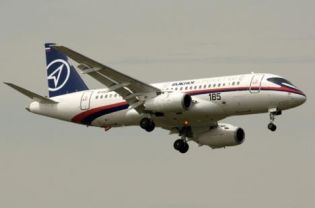
A Sukhoi Superjet 100 takes part in the 48th Paris Air Show at the Le
Bourget airport near Paris in this June 17, 2009 file photo. A Russian Sukhoi
 passenger plane with 46 people on board, including businessmen and Russian
 envoys, has gone missing during a demonstration flight over West Java in Indonesia,
officials said on May 9, 2012. (Reuters Photo/Benoit Tessier)
              
Related articles

Moscow. The Sukhoi jet that crashed in Indonesia killing all on board was a replacement for another plane that had carried out the first part of a promotional tour, its manufacturer said on Monday.

The Sukhoi Superjet 100 — the first new passenger plane produced by Russia since the collapse of the USSR — was making an exhibition flight in Indonesia on a promotional tour to drum up business.

But the plane that crashed was not the same aircraft that carried out the first part of the promotional tour in Kazakhstan and Pakistan, Olga Kayukova, the spokeswoman for Sukhoi Civil Aircraft which makes the plane told AFP.

The Moskovskiy Komsomolets and Kommersant newspapers earlier reported that the plane had been replaced in the middle of the exhibition tour.

Kayukova said that the first model had returned to Moscow after the Kazakhstan leg “to take part in tests,” without giving further details on the reason.

But she added that the second plane was in “perfect technical condition before the flight.”

Images of the planes’ registration numbers posted by bloggers who had been following the whole tour confirmed the reports.

Moskovskiy Komsomolets said that the Superjet shown off in Kazakhstan and Pakistan was number 97005 while the model which crashed in Indonesia was number 97004.

“Why it was replaced, I cannot say,” the paper quoted a source as saying. “But if it was not allowed to make further demonstration flights there must have been a cause.”

It had previously been assumed that the Superjet which crashed last week was the same plane that made the first part of the promotional tour.

At least 45 people, mostly Indonesian airline representatives and eight Russians were on board the plane, which slammed into a dormant volcano after takeoff on Wednesday.

Its loss was a huge blow for the Superjet project, which legendary Russian plane maker Sukhoi hopes will be a major player in the short haul aviation market. So far there have been no official word on the cause of the crash.

Agence France-Presse

Sunday, May 13, 2012

Indonesia Airline Boom Raises New Safety Questions

Jakarta Globe, May 13, 2012

This photo taken on May 11, 2012 and released by Indonesian volunteer
 rescue group Relawan 37 on May 13, 2012 shows an Indonesian soldier
looking at wreckage of the Russian Sukhoi Superjet 100 on the slopes of
Mount Salak, in West Java. Dozens of Russian experts combed a remote
 mountainside in Indonesia on May 13 searching for the flight recorders of a
 Sukhoi jet that slammed into a dormant volcano killing everyone on board.
(AFP Photo/Ho/Duyeh Cidayu/Relawan 37)
              
Related articles

Dozens of fledgling airlines that have sprung up to serve Indonesia’s island-hopping new middle class could jeopardize the archipelago’s recently improved safety reputation, aviation experts say.

The trend threatens to erode higher standards established during what one analyst called a “tremendous amount of soul searching” by major carriers and the government after 2007, when frequent crashes prompted the European Union to ban all Indonesian airlines from landing on its runways for two years.

With growth rates of nearly 20 percent per year, Indonesia is one of Asia’s most rapidly expanding airline markets, but the country is struggling to provide qualified pilots, mechanics, air traffic controllers and updated airport technology to ensure safety. And with so many new, small carriers, it’s hard to monitor all their standards.

“We are not ready for this boom,” said Ruth Simatupang, an Indonesian aviation consultant and former safety investigator.

Indonesia’s two largest airlines — national carrier Garuda and rapidly expanding boutique airline Lion Air — haven’t had a fatal accident in five years and eight years, respectively. But small passenger and cargo carriers plus military aircraft have kept the frequency of crashes to about once every two months, according to statistics compiled by the Aviation Safety Network.

Just how fast Indonesia’s airline market is growing came under a spotlight with Wednesday’s deadly crash of a Sukhoi Superjet 100 plane during a demonstration flight. While both the plane and the pilot were Russian, the flight was packed with representatives of local airlines that the manufacturer hoped would purchase the jetliner.

The number of air passengers in Indonesia jumped by 10 million in a year to 53 million in 2010, according to the government statistics agency, and the upward trend continued last year.

“Infrastructure hasn’t kept pace with the growth of the airlines,” said Shukor Yusof, an aviation analyst in Singapore for Standard & Poors.

He said the government needs to “spend a vast amount of money” to expand safety monitoring for the new carriers and invest in airport runways and technology. He added that the relative ease with which new airlines can be established, though tightened in recent years, has been a concern in the aviation community for years.

In the past five years, Indonesia has added 36 new passenger and cargo airlines, bringing the total to 86 — many of them small carriers serving outlying islands where the only travel alternatives are ferries.

Feeding the demand for new air routes are Indonesia’s population of 240 million, its geography of 18,000 islands and an economy that grew at a 6.5 percent clip last year, creating a larger middle class eager to travel.

“Indonesia is a natural market for growth,” said Brendan Sobie, chief Southeast Asia representative for the Centre for Asia Pacific Aviation. “It’s one of the world’s biggest populations and one of the world’s most underserved markets for airlines.”

Transportation official Herry Bakti Singayuda insists that Indonesia’s rapid airline growth is still compatible with safety.

“We evaluate the operators,” said Singayuda, who directs the Air Transport Department under the Ministry of Transportation. “We control that growth based on their capability, their facilities and personnel.”

He added that the government has expanded flight schools, hired new inspectors and added 10 regional offices to keep up with the new airlines.

Yusof agrees the government and major carriers have markedly improved safety standards in the five years since the EU blacklist, which followed fatal crashes by Garuda and now-defunct Adam Air in 2007.

The government responded with a raft of new regulations and training schools, while Garuda invested millions of dollars to train staff and upgrade its fleet. Lion Air, which recently placed the largest-ever order for Boeing aircraft — 230 planes listed at some $22 billion — has also sought to improve safety, though it took a blow when several of its pilots were arrested in recent months with illicit drugs.

“Garuda and Lion Air have done a tremendous amount of soul searching in terms of safety and in bringing in experts ... to help them clean up their act,” Yusof said. The newer airlines, however, may need more scrutiny.

Smaller airlines serving the domestic market may have less money to invest in training and hiring qualified pilots and mechanics, said Simatupang, the Indonesian aviation consultant.

“There are a lot of new pilots whose flying hours don’t meet the minimum standards, but because the operators need them, they use them sometimes,” she said.

Like Yusof, Simatupang called on the government to do more to regulate the new airlines.

“I always say to the government, please do the new infrastructure and safety regulations first,” she said. “And then allow the airlines to expand.”